DISK/02: a T-shirt label, open for business in a week
DISK/02 is my own graphic T-shirt label: retro computers, hardware and glitches, in heavy type. I ran it the way I’d run a client launch, with me as the client. On day one it was an idea and a working name. Seven days later it had a brand, a domain, a Shopify shop, a print partner and four shirts on sale. No stock, no warehouse, and nothing to post by hand.
Live at disk02.com
The brief
Take a new fashion brand of my own from nothing to selling. That meant the name and identity, a domain, an online shop, a supplier to print and ship the shirts, and the first designs, ready to print.
The label needed its own voice: dry, short and a bit nerdy, aimed at people who grew up with a disk drive and still get the joke. And it had to run without a team. Every order had to get from checkout to a printed, posted shirt without anyone touching it.
The call that shaped everything
Use Shopify for the shop and let Printful do the making.
The first plan was a custom-built site talking to Shopify behind the scenes. For eight designs and one person, that was two systems to build and keep in step. A custom Shopify theme gets checkout, payments, VAT, policy pages and a password-protected soft launch for free, and Printful plugs straight into it.
Printful prints each shirt when it's ordered and posts it. Shopify owns the prices, the orders and the customers; Printful owns the garments, the printing and the delivery. One rule keeps that clean: orders only ever reach Printful through its Shopify app, never by hand or through its API as well, or every shirt gets printed twice.
The brand
The name went through a round of work before it settled. An earlier working name was dropped, DISK/02 was trademark-checked, and disk02.com was secured.
The identity is a chunky floppy-disk icon with a lime write-protect tab, a heavy DISK/02 wordmark and a short D/02 mark, all drawn as vectors so they print sharp at any size. The palette is four colours: system black, disk-green lime, paper and cassette grey. The line is “Insert disk 2 to continue.” An earlier tagline read as innuendo once it was on a shirt, so it went.
The shop
I designed the storefront as a clickable prototype first, then built it as a custom Shopify theme from that prototype. Editorial layout, big product images, the designs grouped into series, and a slide-out bag.
Everything works without JavaScript: the bag, the size picker and adding to cart are plain forms, and the script only makes them smoother. It's built to WCAG 2.2 AA, with visible focus and reduced motion. The UK returns policy and the company's legal details went in before launch, because made-to-order shirts aren't automatically exempt from UK cancellation rights.
The T-shirts
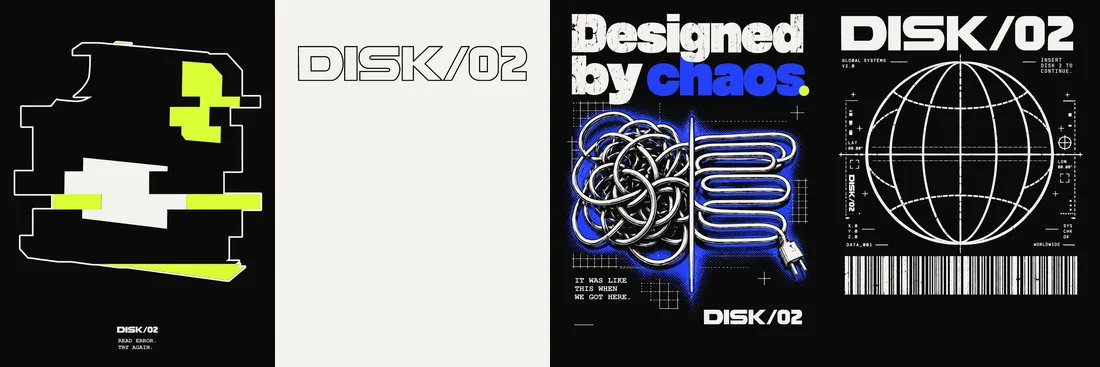
Four launch designs: a glitched floppy disk, the outline wordmark, “Designed by chaos.” (a knot of cable that straightens itself out and ends in a plug) and a wireframe globe. Each one needs a print file at 3600 by 4800 pixels for the shirt, one version for black shirts and one for paper.
Rather than make every file by hand, I built a short pipeline. It takes the artwork, removes any words baked into it, sets the DISK/02 wordmark and captions as real type, snaps the colours to the palette and adds a screen-print texture. Then it runs 14 automatic checks (size, transparency, colour count, lines too thin to print, anything that would vanish on a black shirt) and a visual review before a file goes anywhere near Printful.
The rule that made it work: pictures carry no words. Type is set by code, so it's always sharp and always spelt right. The same pipeline is ready for the next four designs.
Where it stands
Built in October 2026 and soft-launched with four designs. Orders go from the Shopify checkout to Printful, who print and post them. Four more designs across four series are planned, and each new one goes through the same pipeline and the same checks.
What this is really about
A week is enough when the early decisions take work away. Shopify and Printful meant no payment code, no stock and no packing table, so the week went on what a customer sees: the name, the shirts and a shop that feels like the brand.
The same approach works for any small business starting out. Pick tools that do the boring parts well, connect them properly, and spend the time on what makes you different.