
I built everything except the shop

Redogi Handmade Naturals sold their soaps and oils in person, at markets and fairs. They had no website, and a Square shop that was still a work in progress. What they needed was a front door: somewhere to tell the brand story and send people to buy. I built that, and pointed the buying at Square.
Live at redogihandmade.co.uk
The brief
Redogi sold in person, at markets and fairs. There was a half-built Square shop, but no website, and nowhere to send someone who'd heard the name and wanted to know more. No story, no list of the markets they trade at, no single trustworthy place that says this is a real business.
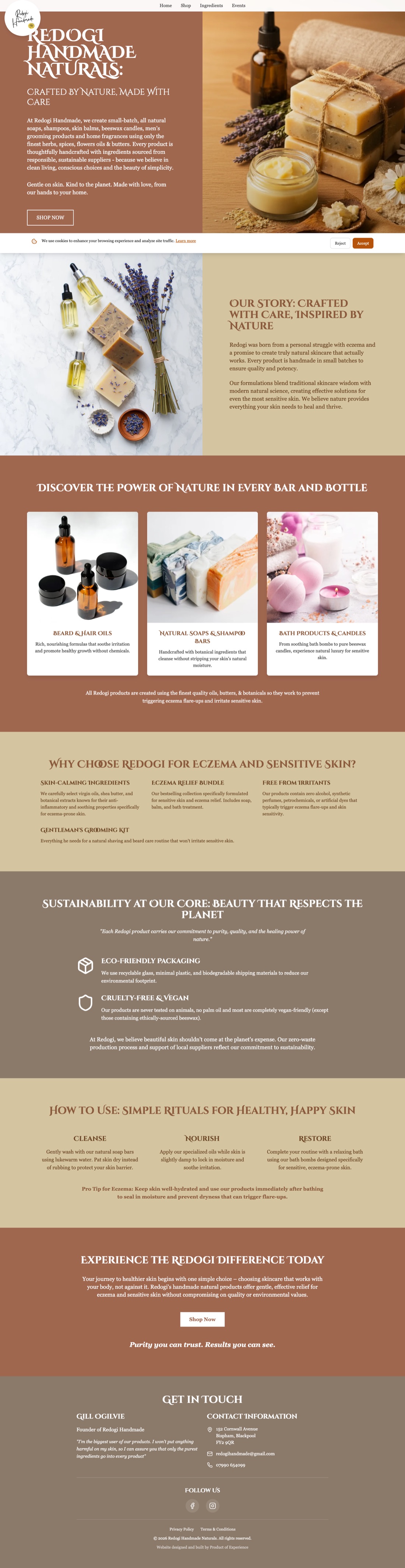
There was a look to hit, too. Redogi's products are natural and handmade, the sort of thing you want to pick up and smell before you buy. The site had to feel the same: warm and unhurried, built around big imagery that shows the soaps and oils up close and carries across what people fall for at the stall.
The owner isn't technical and didn't want to call someone every time the copy needed a tweak or a new market got added. The budget was small, and the running costs had to stay small too.
The call that shaped everything
Don't build the shop. Point at Square.
Square is built for the checkout and the card payments. Building all that into the website would have turned a one-week job into a multi-month e-commerce project, and put me on the hook for taking payments and everything that comes with it. So the website doesn't sell anything.
Its job is to earn trust and send people to the Square shop to buy. Every "buy" link goes straight there. That one decision is what kept the whole thing small.
What I built
A fast brand site with a small content system behind it. The public side is a landing page that tells the story and points to the shop, an events page for the markets and fairs they trade at, a set of ingredient pages so customers can see exactly what's in each product, and the usual privacy and terms pages.
The design leans on the product photography: big, generous images and a warm, earthy palette, with a calm layout that gives the soaps and oils room to do the selling. The page should feel like the products themselves, close enough to almost pick up.
Behind a login, the owner gets a plain dashboard. She can edit any of the homepage copy, add and change events, manage the ingredient pages, and upload images. She hits save, and the site rebuilds and republishes itself. A non-technical owner gets editing that feels live, on a site that's actually static.
There's also a "coming soon" switch I could flip during the soft launch, so the site stayed hidden from everyone but me while we got it ready.
Under the hood
React, TypeScript and Tailwind on the front. The public pages are pre-rendered to static HTML, so the real content is sitting in the page the moment it loads. That's what Google reads, and it keeps the site quick on a phone.
Supabase holds the content and the owner's login, locked down so she's the only one who can change anything. The public pages are just static files hosted on Netlify, quick to serve and simple to run, and they rebuild whenever the content changes. Images get squeezed into modern formats as part of the build.
Where it stands
Built in under a week in March 2026 and soft-launched the following month at one of their live events. It's live now: fast, and reads well to Google. The owner edits the copy and the events herself, and the changes publish on their own. Anyone ready to buy gets sent to the Square shop.
What this is really about
The most useful thing I did was decide what not to build. Square had the commerce covered, so none of the budget went on rebuilding it. It went on the parts that needed the work: telling the story well, and a site the owner can keep fast and current without me.
Knowing what to leave alone is worth as much as knowing what to build. The customer experience that mattered here was a short, trustworthy path from curiosity at a market stall to a confident buy, even though the buying itself lives on Square.
Already paying for something that works?
If a tool you've already got solves half the problem, the smart build is the one that points at it. Let's have a conversation.